Life on board
Technical
The BALI Catamarans' Rigid Forward Deck: Revolution or Fool's Gold? Feedback from Catamaran Guru
A Note From the Editors For this article, we hand over the floor to the team at Catamaran Guru—the official BALI catamarans dealer in the US and renowned specialists in blue water cruising. After hearing every possible theory regarding the rigid forward deck, they wanted to share their own hands-on experience, built over thousands of miles at sea, far from received wisdom. By Estelle and Stephen Cockcroft – Catamaran Guru By Mary and Stephen, from Catamaran Guru

It is probably one of the most frequently asked questions when discussing BALI catamarans:
"Doesn't a fully rigid forward deck penalize the boat's behavior at sea?"
Rather than fueling the debate, we preferred to form our own opinion.
We covered 6,112 nautical miles aboard our BALI 5.4, including a full Atlantic crossing, with a crew ranging from four to eight people depending on the legs. During this journey, we encountered practically all sailing conditions: flat calms, established trade winds, rough seas, and even over 45 knots of wind in the Mediterranean.
By the end of this experience, our perspective on the rigid forward deck had profoundly evolved.
Here is why.

1. Structure and Sea Keeping
One of the most frequent criticisms concerns the assumed weight of a rigid forward deck.
In reality, this idea is largely inherited from old construction methods. Today, thanks to vacuum infusion processes and sandwich structures used by the CATANA Group, it is possible to build highly rigid assemblies while keeping weight perfectly under control.
Besides, this trend is not unique to BALI: most builders are gradually increasing the surface area of their forward platforms.
What interested us most was the boat's actual behavior when the seas built up.
Over the miles, we observed that the BALI 5.4 maintained a healthy trim and recovered naturally after passing waves. We never felt that the forward deck was a handicap or degraded the boat's handling. On the contrary, it always inspired confidence, even in challenging conditions.
2. What Happens When a Wave Breaks on Deck?
Another recurring question: what happens to all that water when a breaking wave washes over the bow?
The answer lies in the design of the drainage system.
On the BALI 5.4, the forward cockpit is equipped with a massive central escape grate, complemented by high-capacity drains in the anchor locker. The entire system is engineered to rapidly clear any volumes of water that might come aboard.
The architects claim that a fully submerged deck returns to its normal state in less than twelve seconds.
During our Atlantic crossing, a large wave did indeed break over the bow. Quite honestly, that is the kind of moment where you immediately watch the boat's reaction. The water drained away extremely fast, and we felt no notable change in the catamaran's behavior or balance.
3. Surprisingly Comfortable Sailing
Slamming is often brought up when discussing catamarans.
During our voyage, we did not find that the rigid forward deck worsened this phenomenon. On the other hand, we immediately appreciated an unexpected benefit: protection from spray.
On a catamaran equipped with trampolines, spray naturally passes through the netting and regularly douses the forward deck.
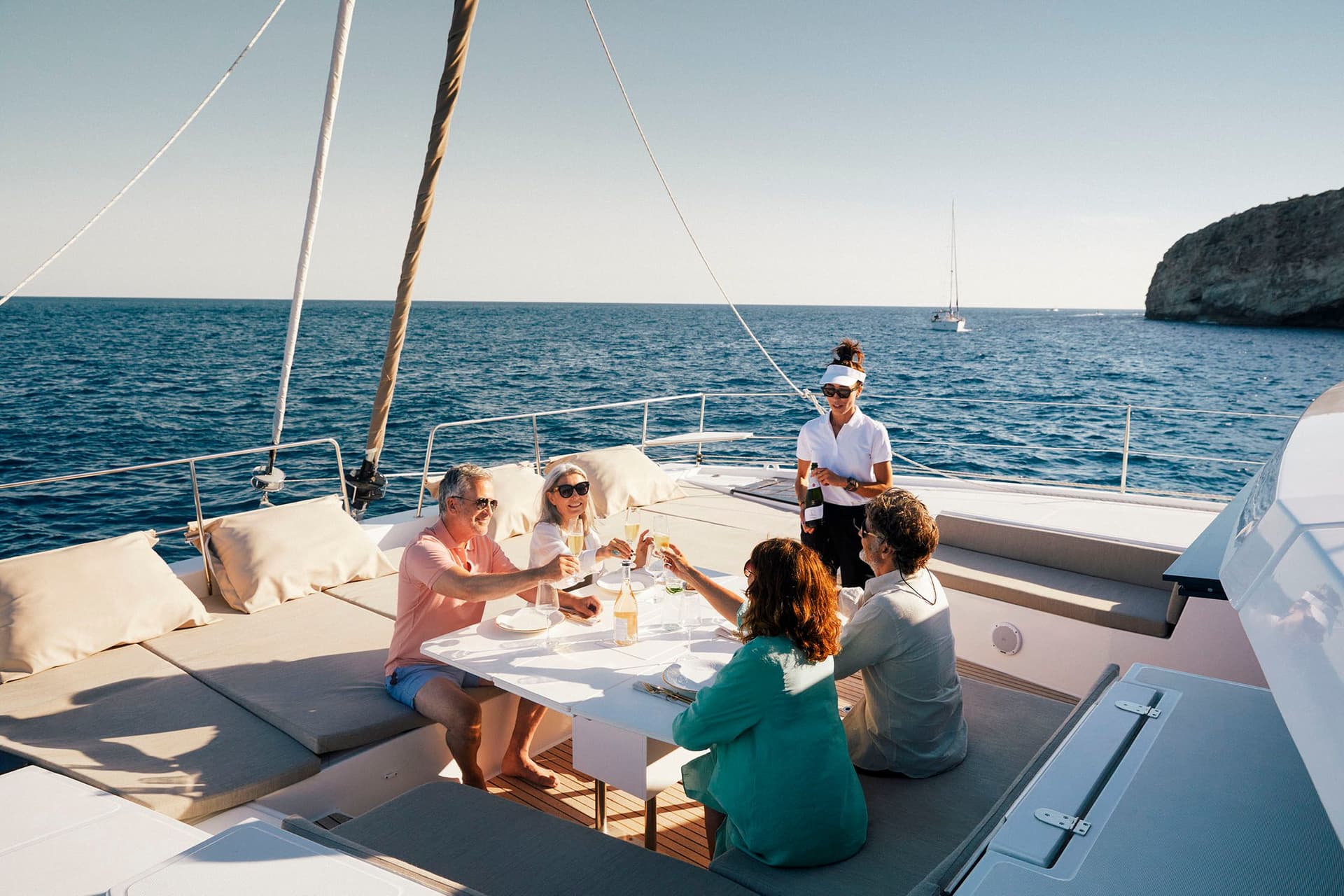
With the BALI’s rigid deck, the space remains surprisingly dry, even as the seas build. Moving around is more pleasant, and the crew can enjoy this space much more easily while underway.
We also appreciated the solid feel of the overall structure, free of any parasitic vibrations or creaking.